
MODERN GUARANTEED POWER SUPPLY SYSTEMS
Creation of highly reliable power supply microgrids using DEIF equipment and solutions
In the current conditions of instability in electricity supply to consumers, especially those classified as critical infrastructure, the issue of ensuring reliable power supply goes beyond simple and conventional solutions such as installing a standard backup generator. Modern realities dictate new approaches to building intelligent microgrids (Microgrids) capable of flexibly combining utility power grids, emergency power sources (diesel generators or CHP units), renewable energy sources (RES), and energy storage systems (ESS).
Relevance and Hybridization of Power Supply Systems
For critical infrastructure facilities – such as healthcare institutions and industrial operations requiring a continuous production cycle (including gas extraction, steelmaking, mining and processing, material handling and transshipment, and the nuclear energy sector) – even short-term power interruptions can lead to significant financial losses at best, and in some cases to man-made technological disasters.
A modern solution to this challenge lies in the “mixing” of various power sources:
1. Centralized grid:
The primary source (utility power grids), which currently cannot be considered a fully reliable supplier and often has limitations on the allocated maximum capacity.
2. Photovoltaic systems (PV):
Grid-tied or hybrid inverters that convert solar energy. Such systems are dependent on seasonal and daily conditions.
3. BESS (Battery Energy Storage System):
High-voltage battery systems that provide instantaneous response to load changes. These act as buffer sources, enabling peak shaving and smoothing load fluctuations.
4. Cogeneration units (CHP):
Highly efficient systems for the combined production of electrical and thermal energy. This direction is key to ensuring energy independence for enterprises, allowing them to cover their own energy needs with a total efficiency of up to 90%, as well as export excess electricity to the grid, contributing to the stability of the unified energy system.
5. Diesel or gas generator units (DG/GP):
A traditional but modernized source of guaranteed power supply, capable of operating both as a short-term (emergency) power source and as a system for continuous operation.
The key factor among all the systems listed above is not merely the presence of these components individually, but their integrated, combined, and – most importantly – seamless interaction with one another.
Technological Advantages: Parallel Operation and Peak Shaving
The main innovation in modern system architectures is the ability of all the above-mentioned systems (PV, BESS, CHP units, and diesel generator sets) to operate in parallel with the main grid and with each other. This enables the following critical functions:
- Seamless Transfer: when grid parameters exceed allowable limits or during a planned transition of consumption partially or fully to island mode (i.e., operation from a local optimal power source under current conditions), the control system adjusts the parameters of the various power sources so that the consumer does not perceive the moment of switching. This eliminates interruptions in continuous technological processes due to power supply disturbances and reduces switching-related discomfort for less sensitive consumers.
- Peak Shaving: the system monitors real-time consumption from the main grid. When approaching the contracted power limit (which may result in penalties or disconnection), intelligent controllers initiate the start of diesel generators or discharge of battery storage systems. External grid consumption is “capped” at the permitted level, while the deficit is covered by internal energy resources.
- Mains Power Export: the system enables exporting surplus energy from local generation sources into the main power grid according to predefined algorithms and operating rules. This is used either for electricity sales or for balancing the higher-level power supply system.
Hardware Implementation Based on DEIF Controllers and Schneider Electric Power Distribution and Protection Equipment
To implement such complex algorithms, equipment with high-speed signal processing capabilities and mutual integration protocols is required.
Schneider Electric traditionally acts as the provider of the power section. Its wide range of low- and medium-voltage switching equipment ensures reliable physical switching and protection of various networks, providing safe and dependable circuit switching and protection.
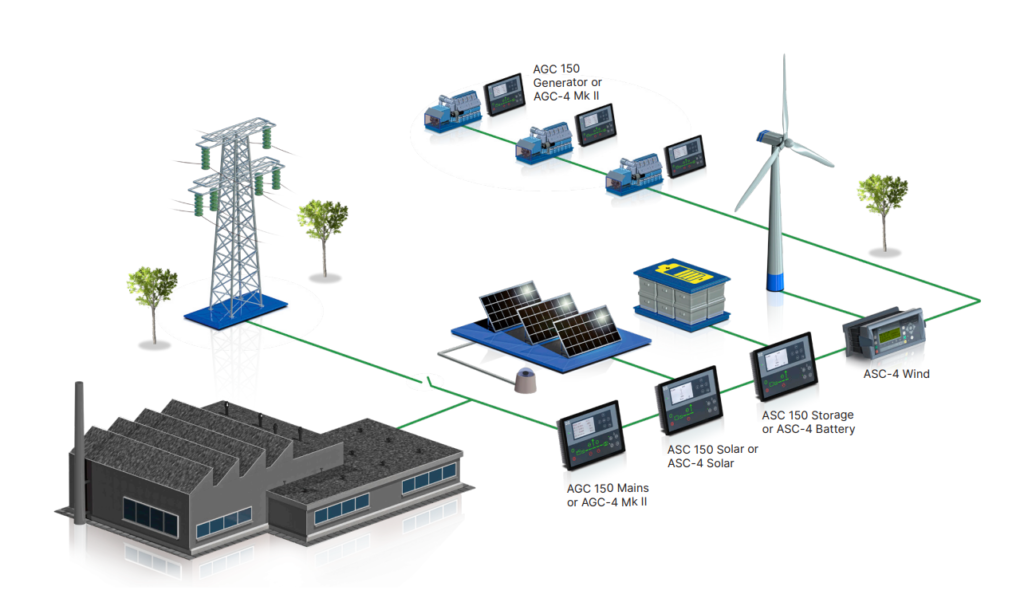
The “brain” of the synchronization and load distribution system consists of controllers from DEIF. The following specialized units are used in the considered system:
1. AGC-4 Mk II (Advanced Genset Controller):
A flagship controller designed for managing diesel or gas generator sets. It supports up to 32 generators operating in parallel and synchronization of up to 56 breakers within a single system. The controller provides automatic start/stop based on load demand, frequency and voltage control, and full compatibility with the ASC-4 controller series.
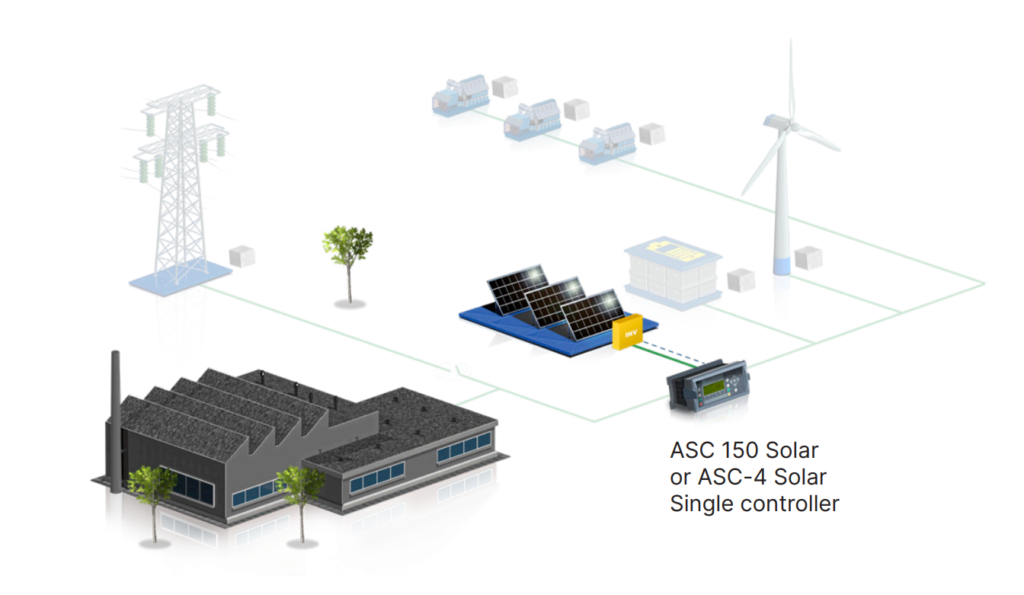
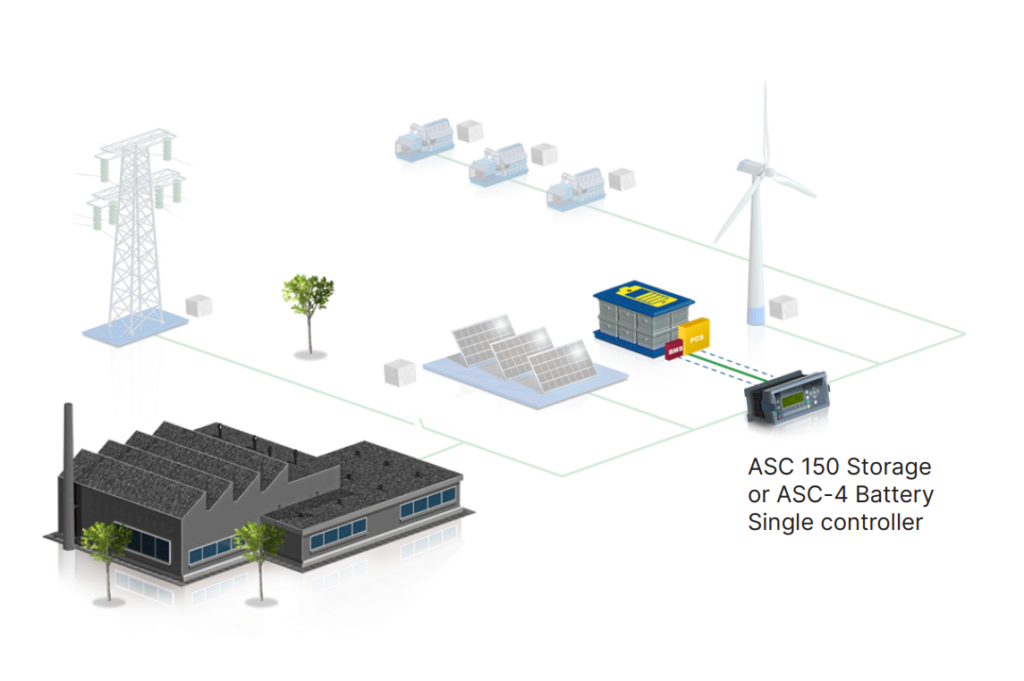
2. ASC-4 (Advanced Sustainable Controller Series):
A range of specialized controllers for integrating renewable energy sources (RES) and energy storage systems (ESS) into hybrid microgrid solutions.
2.1. ASC-4 Solar: Provides communication between solar inverters and the Power Management System (PMS). It automatically maximizes solar generation while enforcing minimum generator load constraints to prevent reverse power flow.
2.2. ASC-4 Battery: Manages charging and discharging processes of battery energy storage systems (BESS) based on state of charge (SoC) or predefined schedules. It supports grid-forming operation modes and functions as a virtual synchronous generator in droop mode.
3. AGC-4 Mains: а mains controller for the point of common coupling (PCC). It is responsible for monitoring external grid parameters and implementing Peak Shaving logic. The system uses diesel generator sets or battery discharge to keep grid import at a predefined limit, preventing exceedance of contracted power thresholds.
Energy efficiency and an integrated approach
Energy efficiency of hybrid systems (Microgrids) is evaluated not only in terms of fuel savings, but also in terms of equipment lifecycle optimization.
- Diesel generator set (DG) lifetime savings: Thanks to battery storage systems (BESS), generators do not operate at low loads (where their efficiency is minimal) and are engaged only within their optimal operating range.
- Reduction of carbon emissions: Maximum utilization of renewable energy sources supported by energy storage systems.
- Reduction of operational costs: Elimination of penalties for exceeding consumption limits and reduction of electricity procurement costs during peak hours (when time-of-use tariffs are applied).
Conclusion
The implementation of our engineering solutions based on DEIF and Schneider Electric equipment enables the creation of a reliable, flexible, and fault-tolerant system where autonomous generation, renewable energy, storage systems, and the grid operate as a single organism. This approach to intelligent power management becomes a decisive competitive advantage in modern industry.
The key components for building and controlling such microgrid systems have been selected as equipment from DEIF.